
Design Features of the Roeders Machines
Roeders’ machines are optimised for roughing and finishing operations on a wide range of materials (steel, aluminium, titanium, copper, carbide, ceramics, glass, graphite, etc.) using milling and/or grinding. The focus lies on highest precision, best surface finishes and shortest possible machining times. Complete processing in one single set-up, on 3- or 5‑axis machines, including deep-hole drilling and thread cutting, minimise throughput times. In many applications, reliable quality control can also be carried out by directly measuring in the machine. A machine technology that has been carefully thought through in every detail and is covered by multiple patents gives the machines their unrivalled performance and reliability.
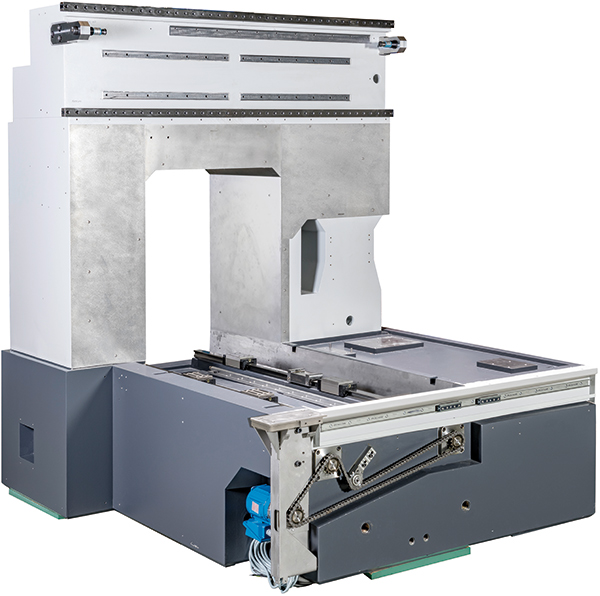
The machines, which are exceptionally robust and heavy, are generally designed as portal structures, as this is the most precise design, albeit a more costly one. Low moving masses allow for high dynamic performance in all axes. Since year 2010, Roeders has been manufacturing only machines with direct-drive technology (linear and torque motors) in all axes. The machines are installed well-defined and without distortion on three machine feet.

As a pioneer in the development of linear motor machines, Roeders recognised at an early stage the importance of a friction-free weight compensation for the vertical Z‑axis that does not affect control accuracy, and developed a patented solution using vacuum hoses. These also have the advantage that no heat is generated, even during dynamic movements of the Z‑axis. This makes it possible to achieve extremely small positioning increments in sub-micrometre range in the Z‑axis without problems.
Roeders machines were initially developed for the company’s own mould making operations, so great care was taken from the very beginning to ensure a highly practical design. Generously sized windows and doors allow the operator to view and access the machining area from two sides. Automation is usually carried out from the front, so that for the automation the machining area is accessible via the front door, whilst the tool changer, located next to it, is accessible via a separate flap, allowing the handling system to automatically load workpieces and tools. Naturally, crane loading is possible on all machines.


The design of direct-drive axes with linear or torque motors is impressively simple and compact. Even a layperson can immediately see that axes with direct drives are the more precise and dynamic solution compared to ball screw driven axes, particularly if linear scales interpolated to a resolution of 1 nanometre are used. The minimal number of moving parts ensures an extremely low risk of failure and prevents wear. Roeders exclusively relies on highly rigid roller guideways. In high-precision applications, these can be temperature-controlled using a cooling circuit. Here too, Roeders was a pioneer.
Over several years of development, Roeders optimised the thermal behaviour of the machines, culminating in the PRECITEMP® technology. Numerous temperature-controlled circuits prevent thermally induced deformation of the machines, particularly due to internal heat sources such as the motors.
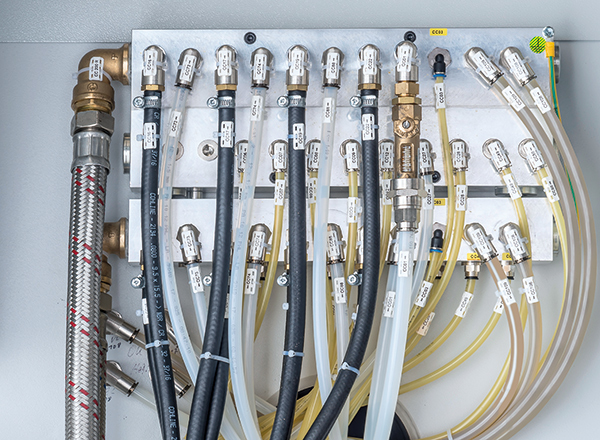
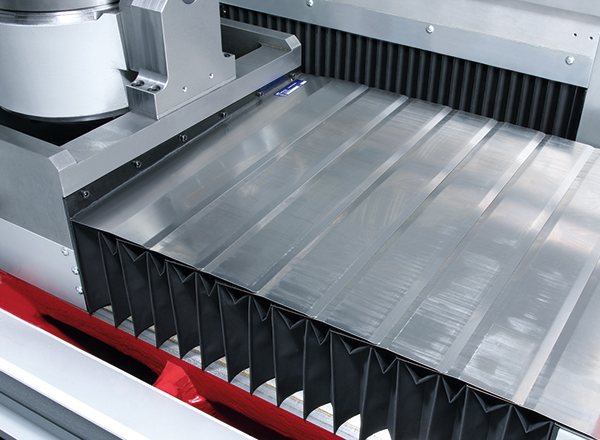
To ensure a high-precision control of the movement of the linear axes, it is essential to minimize friction as much as possible. That is why Roeders has relied for many years on bellow-covers with slats, which are virtually friction-free.
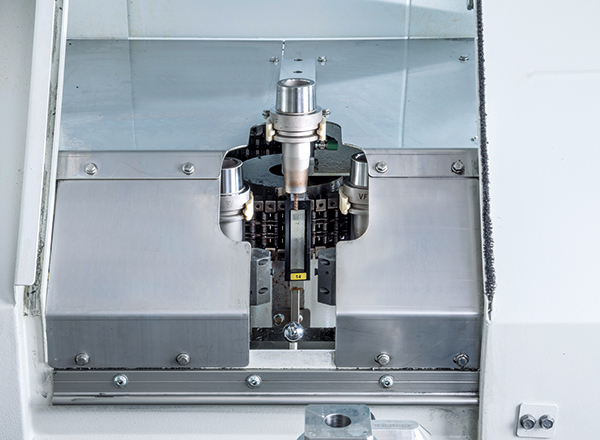
During tool changes, no chips should fall between the tool holder and the spindle shaft. Roeders therefore gives particular importance to chip protection during tool changes. There is always only one tool holder in the machining area at any time – the one that is currently being inserted into or removed from the spindle.