
Roeders Precision Technologies
PRECITEMP® — High precision also in case of temperature fluctuations in the workshop
In most applications, temperature fluctuations in the workshop are the main cause of inaccuracies during machining. This also applies to air-conditioned workshops, where the temperature often only fluctuates by a few degrees. This has therefore been a focus of development at Roeders in recent years. The result is the unique PRECITEMP® technology, which enables a temperature-resistant optimization of the machine for maximum precision with a graduated concept depending on the requirements. The machine has been viewed holistically and a comprehensive solution for temperature control of all machine components has been developed. Minimal residual errors are eliminated with software compensation.
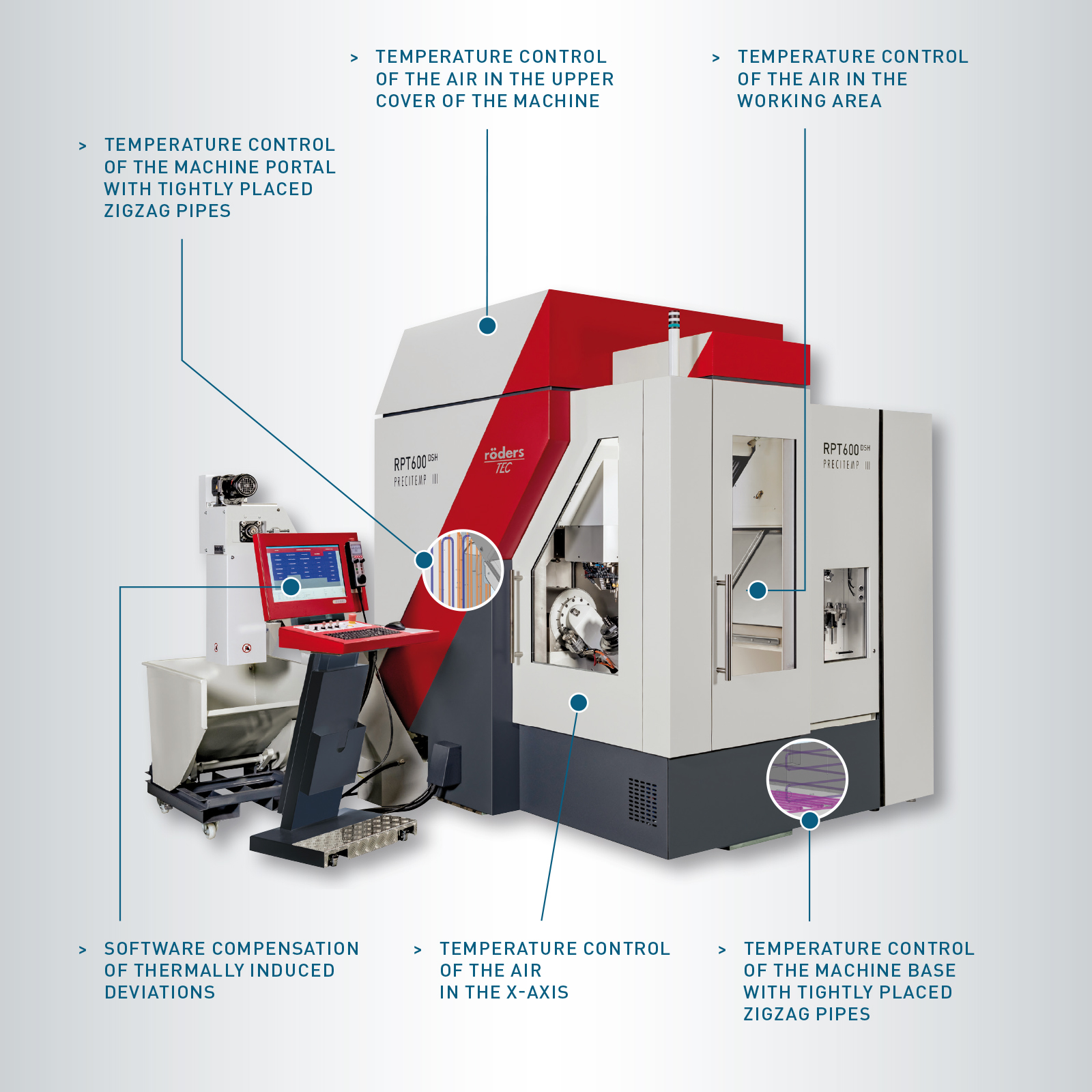
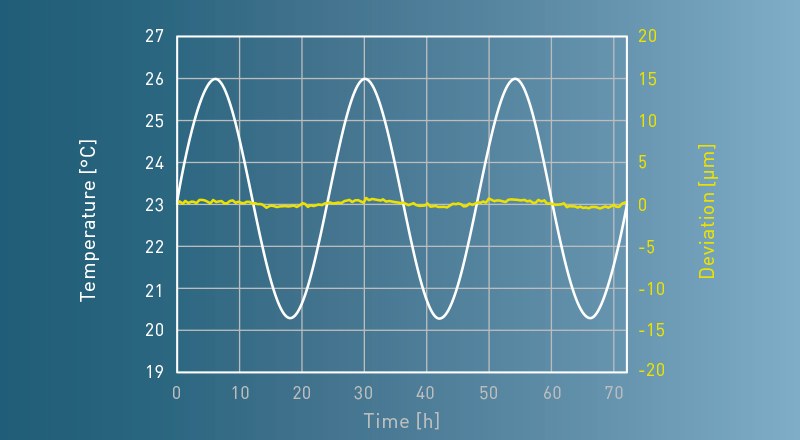
Heat sources in the machine such as motors, main spindle, linear guideways (optional) and rotary axis bearings are also temperature-controlled with high precision. As a result, the zero point of the machine is within +/- 1 µm, even with temperature fluctuations in the workshop of up to +/- 3°C.
PRECITEMP® E – Precision with Emulsion
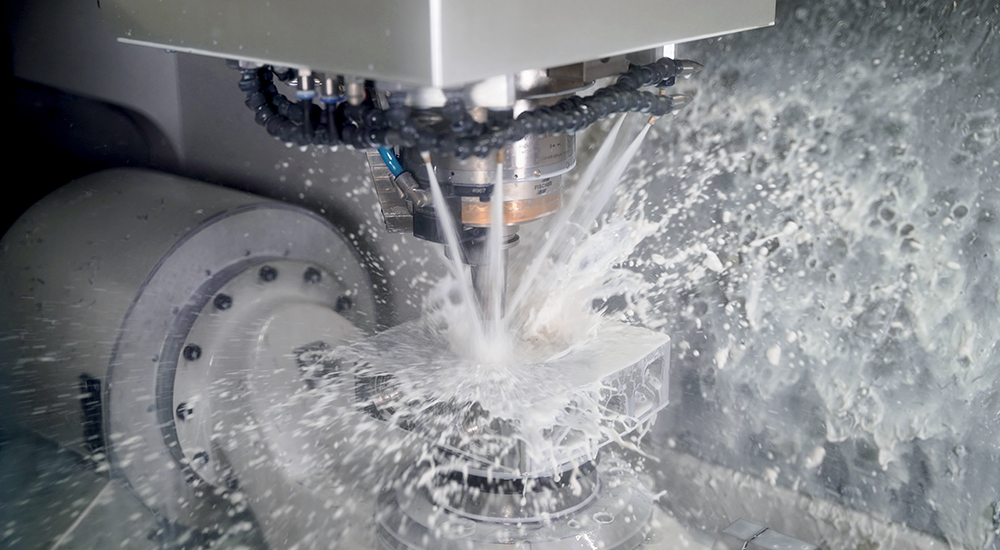
During milling or grinding operations using emulsion, the water contained in the emulsion evaporates, causing the temperature in the machine’s working area to drop sharply – in some cases by well over 10°C. This leads to thermally induced deformation of the machine’s geometry, the workpiece, etc., and consequently to inaccuracies, particularly in 5‑axis machines. Roeders has therefore developed a variant PRECITEMP® E for machining with emulsion, which prevents the cooling effect caused by the evaporation of emulsion in the working area. Through comprehensive temperature control of the machine, PRECITEMP® E goes even further, maintaining the machine’s geometry stable even if the ambient temperature around the machine fluctuates, thereby ensuring that machining with µm-level precision can be carried out reliably.
Further information in our technical report or on YouTube.
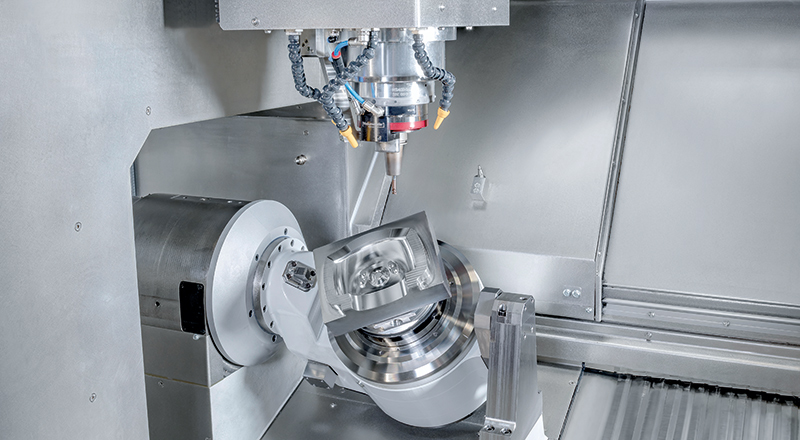
For the first time on the 5‑axis RPT Machines, the rotary axis bearings and machine table can also be temperature-controlled. In addition, the torque motors in the rotary axes have Roeders’ own greatly improved temperature control. Dimensional deviations at higher rotational speeds or under high torque loads on the torque motors are avoided.
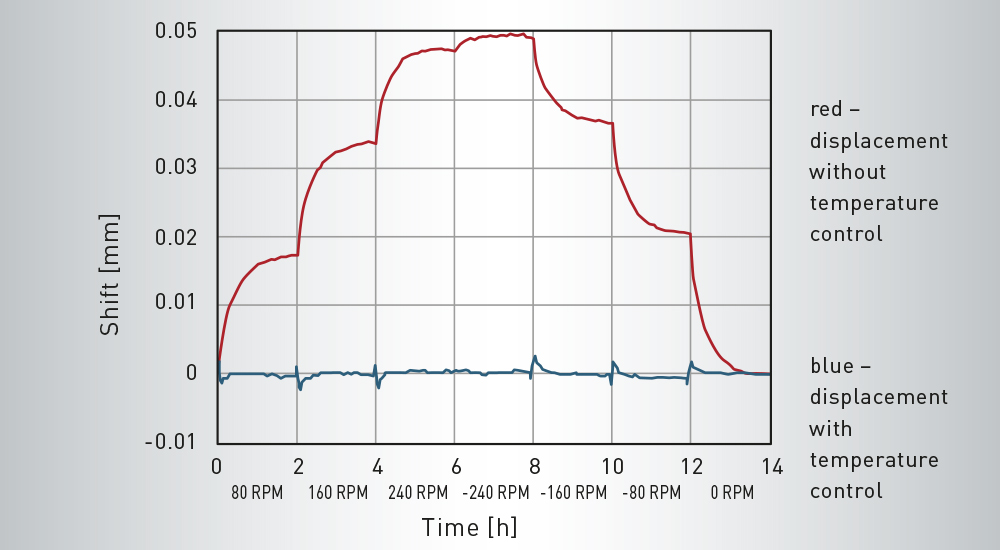
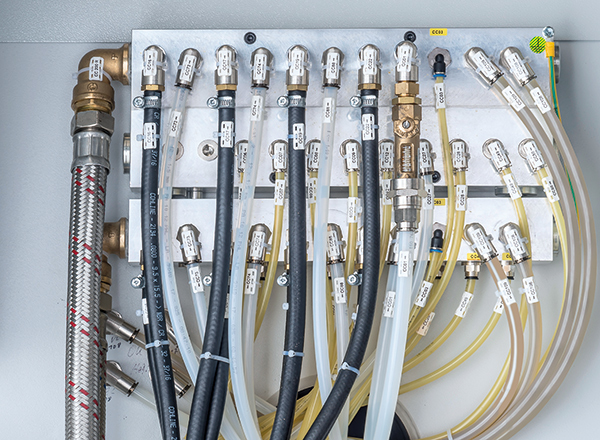
All heat sources within the machine are temperature-controlled by numerous temperature-control circuits. Where highest precision is required, the guideways can directly be temperature-controlled.
The hysteresis of the cooling water used to regulate the machine’s temperature is less than < +/- 0.1 Kelvin. In case of special requirements, this can be reduced to +/- 0.02 Kelvin.