
Control and Drive Technology
Roeders develops the control system and drives, electronics and mechanics of its high-precision machining centres in-house. This vertical integration is the reason Roeders machines reach submicron precision at short machining times — and why they can be kept technically up to date over a service life of up to 30 years.
This page explains how the RMS6 control, the RACECUT® function, the 32 kHz clock frequency in the drive modules and the NANOTOL® and PRECITEMP® technologies work together to achieve high-precision milling and grinding results.
Why Roeders develops its control and drive technology in-house
Most machine tool builders source control systems and drives from external suppliers. Roeders develops them itself.
Roeders designs and builds the three elements that determine machining accuracy as a single, coordinated system: the control system, the drives and the machine mechanics. Because these elements are developed under one roof, they can be tuned to each other and adapted to application-specific requirements instead of being limited by the interfaces of bought-in components.
- Control system: the RMS6 CNC control, developed and maintained by Roeders.
- Drives: drive modules with a 32 kHz clock frequency, matched to the control.
- Mechanics: machine structure and guideways designed for high-precision milling and grinding (see the NANOTOL® concept for high-precision guideways).
- Measuring systems: position feedback via optical scales (those are bought).

Because Roeders develops control, drives and mechanics in-house, the entire signal chain — from the machining program to the axis position — is designed as one system. This is the technical basis for submicron precision and for keeping older machines up to date.
The RMS6 control system
The RMS6 is Roeders’ own CNC control.
| Property | Value |
|---|---|
| Block processing time | < 0.1 ms |
| Lookahead | > 10,000 blocks |
| 3D performance function | RACECUT® |
| Vibration behaviour | Automatic vibration minimization |
| Path transitions | Tangential and curvature constant transitions between blocks |
A short block processing time combined with a lookahead of more than 10,000 blocks allows the control to keep the feed motion smooth across many small program blocks — the situation that is typical for fine 3D surfaces. Tangential and curvature constant transitions between blocks avoid abrupt direction changes that would otherwise leave marks on the surface.
RACECUT® and the 32 kHz clock frequency in the drive modules
RACECUT® — performance in 3D machining
RACECUT® is a function of the RMS6 control for 3D machining. It enables up to 20 % shorter machining time at the same surface quality.
32 kHz clock frequency in the drive modules
The drive modules operate with a clock frequency of 32 kHz. A high clock frequency means the axis position is corrected very frequently, which keeps the actual tool path close to the programmed path — a prerequisite for submicron accuracy at high feed rates.
How this technology reaches submicron precision
Submicron precision — accuracy below one micrometre — is the result of the whole system working together, not of a single component. High Speed Cutting (HSC) is the machining strategy that turns the control and drive performance into fine surfaces.
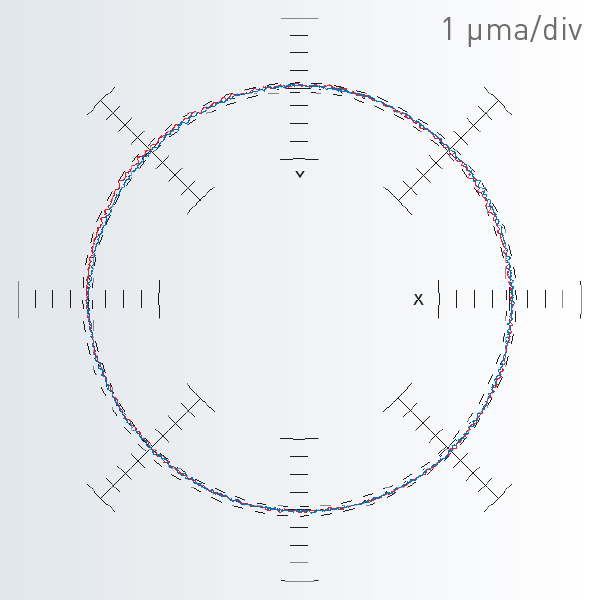
In short: the RMS6 control plans the tool path with high lookahead, the 32 kHz drive modules follow that path closely, the optical scales report the true axis position, and the machine mechanics keep the process stable. A dedicated page explains HSC and submicron precision in more detail.
NANOTOL® and PRECITEMP® technologies
NANOTOL® and PRECITEMP® are registered Roeders technologies.
- NANOTOL® — the Roeders concept for high-precision guideways that support fine, stable motion.
- PRECITEMP® technology — a Roeders technology contributing to the machines’ dimensional stability during precision machining, also at long machining jobs and if the ambient temperature is not stable.
Upgradeability and control updates — machines that keep their value
Because Roeders develops its control in-house, it can supply control updates for older machines.
Control updates are available for Roeders machines built from 1995 onwards, at low cost. This means a Roeders machine does not become technically obsolete when a new control generation is released: the existing machine can be brought up to a current control state, protecting the customer’s investment over a service life of up to 30 years, which is typical for this class of machine.
A Roeders machine can be kept up to date instead of being replaced. Control updates from build year 1995 onwards protect the investment and keep the machine productive over its full service life.
Standardized data transfer (umati / Industry 4.0)
Roeders is an umati partner (VDW). umati provides a standardized interface for machine data, which makes it easier to integrate Roeders machines into digital, Industry‑4.0 production environments.
Frequently asked questions
Yes. Roeders develops the CNC control system (RMS6), the drives and the machine mechanics in-house. This is the basis for adapting the machines to application-specific precision requirements.
The RMS6 is Roeders’ own CNC control. It has a block processing time below 0.1 ms and a lookahead of more than 10,000 blocks, and it uses a modern refined spline interpolation — properties that support high-precision 3D machining.
RACECUT® is a function of the RMS6 control for 3D machining. It enables up to 20 % shorter machining time at the same surface quality.
Yes. CNC control updates are available for Roeders machines built from 1995 onwards, at low cost, so that older machines can be kept at a current CNC control state.
Through the combination of the in-house developed CNC control and drives, the 32 kHz clock frequency in the drive modules, position feedback via optical scales, and High Speed Cutting (HSC) as the machining strategy.