
HSC and Submicron Precision
Submicron precision means machining accuracy below one micrometre. Roeders reaches it by combining High Speed Cutting (HSC) with control and drive technology developed in-house. This page explains what HSC is, what submicron precision means in practice, and which technical elements make it possible on a Roeders machine.
What is High Speed Cutting (HSC)?
High Speed Cutting is a machining strategy that uses high spindle speeds together with small step-overs and light cuts. Instead of removing material in a few heavy passes, the tool takes many fine passes at high speed. The result is a fine surface finish, low cutting forces, and less heat introduced into the workpiece — which is important when the finished part has to hold accuracy below one micrometre.
- High spindle speeds for a high number of cutting engagements per minute.
- Small step-overs and shallow cuts for fine surfaces.
- Low cutting forces, which keep the workpiece and tool stable.
- Reduced thermal load on the workpiece compared with heavy conventional cutting.
Which features are best finished by milling and which by grinding is compared on Milling or grinding for high precision parts.
What does submicron precision mean?

Submicron precision means that the deviation between the programmed geometry and the finished part stays below one micrometre — smaller than a thousandth of a millimetre. At this level, the machine must keep the tool exactly on the programmed path, report the true axis position, and stay dimensionally stable during machining. A single weak link in this chain would be visible in the result. Which precision level is reached depends on the application — Roeders shows applications in which it is below one micrometre.
How a Roeders machine reaches submicron precision
Submicron precision is the result of several elements working together. Each of these is described in more detail on the control and drive technology page.
| Element | Contribution to submicron precision |
|---|---|
| RMS6 control | Block processing time < 0.1 ms and lookahead > 10,000 blocks keep the feed smooth across fine 3D paths. |
| 32 kHz drive modules | The clock frequency of 32 kHz corrects the axis position very frequently, keeping the tool close to the programmed path. |
| Optical scales | Position feedback via optical scales reports the true axis position with high resolution back to the control. |
| NANOTOL® concept | High-precision guideways support fine, stable motion. |
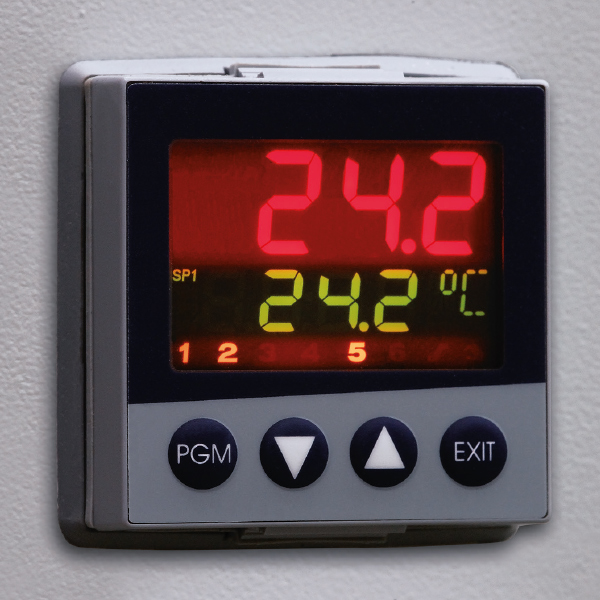
| PRECITEMP® technology | Contributes to the machine’s dimensional stability during precision machining, also at longer operations and if the ambient temperature is not stable. |
Where submicron precision matters
Submicron precision from HSC milling and grinding is relevant in application fields where surface quality and dimensional accuracy are critical.
- Optical components
- Carbide machining
- Mould and die making
- Precision part manufacturing
- Jig (coordinate) grinding
- Ceramics and glass machining
Frequently asked questions
Submicron precision means machining accuracy below one micrometre — smaller than a thousandth of a millimetre. Roeders reaches it by combining High Speed Cutting with control and drive technology developed in-house.
HSC is a machining strategy that uses high spindle speeds with small step-overs and light cuts. It produces fine surfaces with low cutting forces and less heat in the workpiece.
The RMS6 control (block processing time < 0.1 ms, lookahead > 10,000 blocks), the 32 kHz drive modules, position feedback via optical scales, the NANOTOL® guideway concept, the PRECITEMP® technology and the solid and heavy portal design of the mechanics of the machine.
For optical components, carbide machining, mould and die making, precision part manufacturing, glass and ceramics machining and jig grinding — all within milling and grinding.