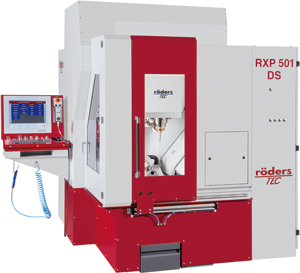
RXP500DS

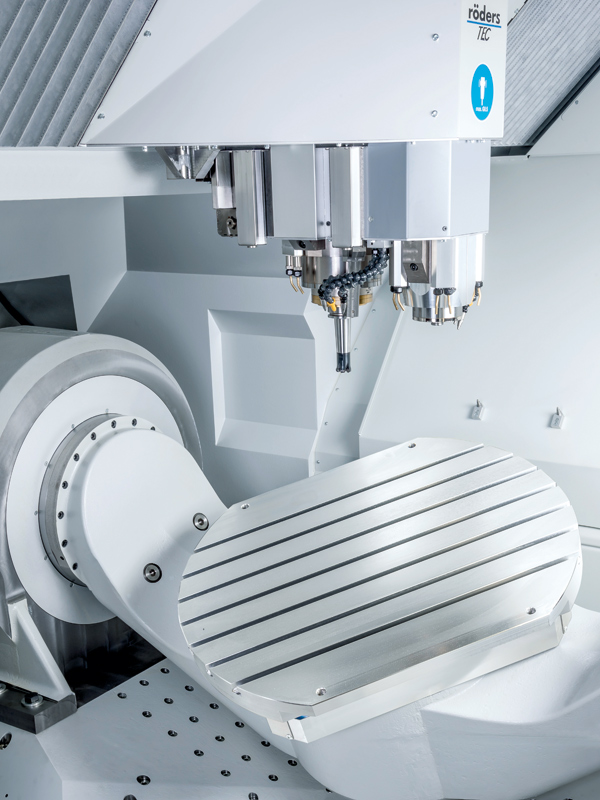
RXP500DS – 5‑axis machine
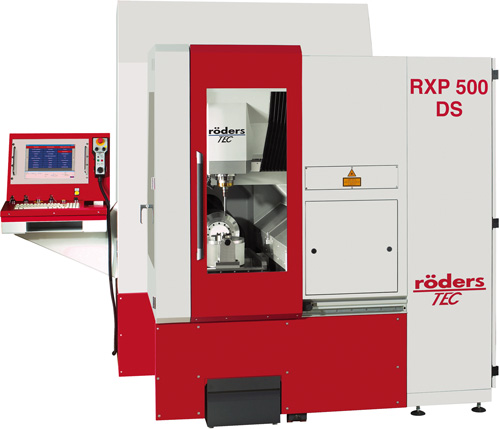
Maschine RXP500DS

Compact, highly dynamic, high-precision
5‑axis HSC machine

  • With counter bearing and special Röders geometry compensation

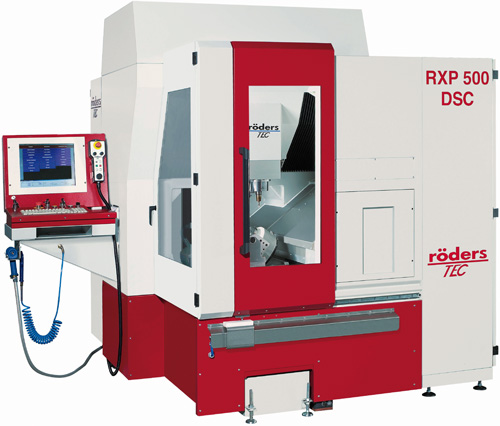
RXP500DSC

RXP500DSC – 5‑axis machine

Maschine RXP500DSC

Optimised geometry for better machining access in opera­tions with large swivel ranges

  • Inertia reduced further compared to the RXP500DS, therefore no break in the C axis
  • Workpiece in the centre of the swivel axis
    only small compen­sation movements by the linear axes
  • Special Röders geometry compensation

RXP501DS

RXP501DS – 5‑axis machine

Maschine RXP501DS

Compact but rigid 5‑axis HSC machine

  • Large choice of machining spindles 
  • With second bearing for swivel axis guaran­teeing high stiffness

RXP501DSC

RXP501DSC – 5‑axis machine

Maschine RXP501DSC

C‑axis more eccentric compared to RXP501DS

  • Better access to workpiece for large swivel angles
  • With second bearing for swivel axis
    guaran­teeing high stiffness
  • No break for C‑axis

RXP601DS

RXP601DS – 5‑axis machine

Maschine RXP601DS

Highest possible dynamics through extremely powerful direct drives, also in the rotary axes
  • Highly precise due to special Röders geometry compensation
  • Standard chucks, including UPC Erowa, may be integrated
  • Machine fits into a standard container for transportation

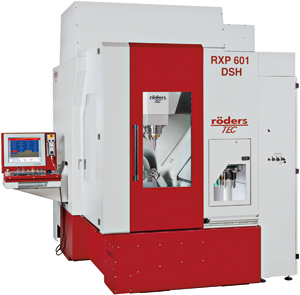
RXP601DSH

RXP601DSH – 5‑axis machine

Maschine RXP601DSH

Highest possible dynamics through extremely powerful direct drives, also in the rotary axes

  • Highly precise due to special Röders geometry compensation
  • Maximum workpiece size in height and diameter signi­fi­cantly larger than on RXP601DS

RXP950DSH

RXP950DSH – 5‑axis machine

Maschine RXP950DSH

Highest possible dynamics through extremely powerful direct drives, also in the rotary axes
  • Highly precise due to special Röders geometry compensation
  • Strong rotary and swivel unit, identical with the one of the RXU1001DSH

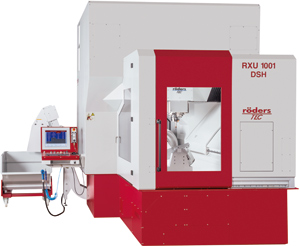
RXU1001DSH

RXU1001DSH – 5‑axis machine

Maschine RXU1001DSH

With QUADROGUIDE for high roughing capacity, dynamics and precision
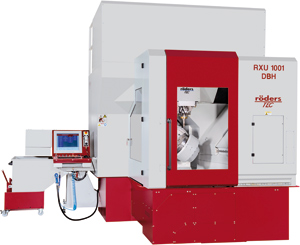
  • All axes with direct drives
  • Milling spindle may be chosen depending on the appli­cation, up to 102 Nm (S1) available
  • Compared to the RXU1000DSH the travel in X‑direction and the maximum workpiece diameter are increased, the offset of the C‑axis is higher

RXU1001DBH

RXU1001DBH – QUADROGUIDE

Maschine RXU1001DBH

Special machine design for machining BLINGS and similar workpieces from two sides in one set-up
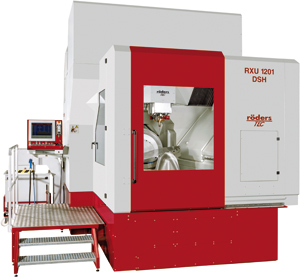
  • With QUADROGUIDE for high stability and dynamics 
  • All axes with direct drives
  • Milling spindle may be chosen depending on the appli­cation, up to 102 Nm (S1) available

RXU1201DSH

RXU1201DSH – 5‑axis machine

Maschine RXU1201DSH

With QUADROGUIDE for high roughing capacity, dynamics and precision
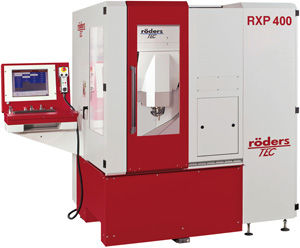
  • All axes with direct drives
  • Milling spindle may be chosen depending on the appli­cation, up to 102 Nm (S1) available
  • Ideal for forging dies, mould and die making, aerospace industry, medical appli­ca­tions, machine production and part manufacturing

RXP400

RXP400 – 3‑axis machine

Maschine RXP400

Optimized for

  • Micro-machining
  • Minting technology
  • Small steel moulds
  • Electrodes

RHP Machine Models

RHP Machines

The RHP machines differ from the RXP machines in terms of the guideway concept. Hydro­static guideways in all axes improve the running perfor­mance significantly:

  • Micro-movements across the travelling direction of the axes in the sub-micro­metre range, as encoun­tered with roller guideways, are reliably prevented.
  • The controlled hydro­static oil film between the moving slide and the guideways provides additional damping.
  • The precise tempe­rature control of the hydro­static oil is effective directly at the guideways, prevents tempe­rature fluctua­tions and hence thermally caused defor­mation of the machine geometry.
  • Because the axis covers and weight compen­sation for the Z axis (patented) are optimised for minimum friction, the axes exhibit an ideal drive control response.

The funda­mental technology of the RHP machines corre-sponds to that of the RXP series: linear motors in all axes, Röders RMS6 control, exact tempe­rature stabi­li­sation, compen­sation of the spindle elongation etc.


  • Hydro­static axis construction with hydro­static guideways preten­sioned by the magnetic field of the linear motor
  • High-precision glass scales with a position resolution of 1 nanometre
  • Wear- and friction-free

Less micro-movements across the travel direction and therefore a much smoother running of the axis slide with hydro­static guideways in compa­rison to guideways with roller or ball bearings


Options
The manifold options for the RXP series are also available for the RHP machines, e.g. rotary swivel units for 5‑axis machining etc. The RHP machines are excel­lently suited to the combi­nation of HSC milling and grinding.


3‑achsig:
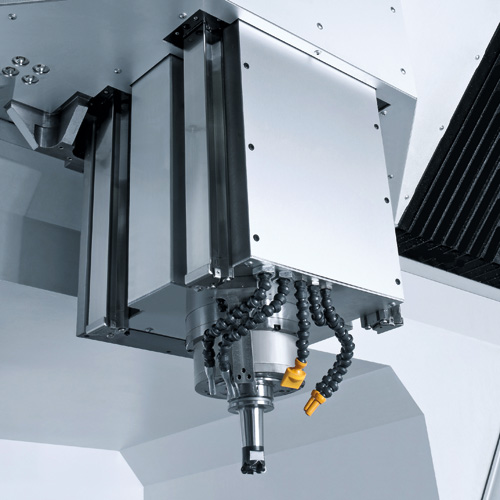
RHP500

RXU Machine Models

QUADROGUIDE – Extremely Stiff RXU Machines

Achse RXU Quadroguide

Is it possible to design a machine with high stiffness, high dynamics and high precision?
QUADROGUIDE – a totally new concept combines those charac­te­ristics in an ideal manner. The trans­mission of the forces from the cutter along Z axis and Y axis into the machine body has been optimized with totally new machine design. Very high stiffness is achieved with low inertias.

4 guiding rails in the 4 corner edges of the Z axis transfer the accele­ration and the machining forces with the means of 16 guiding carriages with high damping into a massive machine bridge.

Linear motors and modern drive technology enable the RXU machines for unpre­ce­dented dynamics and precision.

Spindles with more than 100 Nm torque (S1 operation) and 22,000 rpm allow a large variety of applications.

High roughing capacities in hardened steel or difficult to machine materials and highest surface qualities and precision are achieved in one set-up.

3 axes:

RXU1001
RXU1401
RXU2000
RXU2600

5 axes:

RXU1001DSH
RXU1201DSH
RXU1201DSXH

RXP Machine Models

The RXP Machines

Hochsteife Portalkonstruktion

are the result of a long-lasting develo­pment process in Röders HSC machine construction. With multiple patents and optimized in every detail, these low-wear and energy-saving linear motor machines achieve the highest possible precision, dynamics and surface qualities possible in numerous appli­cation areas.

3 axes:

RXP400
RXP500
RXP501
RXP801
RXP950

5 axes

RXP400DS
RXP400DSC
RXP500DS
RXP500DSC
RXP501DS
RXP501DSC
RXP601DS
RXP601DSH
RXP950DSH

Double Spindle Machine – Option “Z2”

Machine Design

Röders Maschinenbau Achse große Maschine

Structural Features
of the Röders Machines

Very rigid portal design

  • Heavy, robust machine frames
  • Low moving masses
  • Linear and torque motors (direct drives) in all axes
  • Easy instal­lation with 3‑point support

Patentierter Gewichtsausgleich, Patented weight compensation, © Röders GmbH

Patented frictionless weight compensation

  • Constant force over the entire positioning range
  • Frictionless vacuum hoses without stick-slip effect
  • Optimal for highly precise drive control of the Z axis

RPT600DSH, © Röders GmbH

Practice-oriented design

  • Good visibility through generously dimen­sioned windows
  • Good acces­si­bility to the working area from two sides
  • Crane loading possible

Kompakte hochsteife Konstruktionen

Compact, highly rigid construction

  • Linear motors in all axes for highest possible accuracy and dynamics
  • No moving parts, no wear, high reliability
  • Roller guideways for low friction, low heat generation and, at the same time, very high rigidity
  • High-precision linear scales

Kettenwechsler mit Roboterbeschickung

Robot loading of tool changer

  • Chain changers also acces­sible for automatic loading with external tools by a robot or other handling systems through a separate lift gate without inter­rupting machining

Zahlreiche Wasserkreisläufe

Large number of water circuits

  • Machines completely tempe­rature-stabi­lised, due to a large number of water circuits
  • For highest precision the guiding rails and carriages are optio­nally tempe­rature controled with a water circuit directly through the rails and carriages themselves

Achsabdeckungen

Axis covers

  • Frictionless axis covers for best possible dynamics and accuracy

Späneschutz

Protection against chips

  • Special precau­tions taken – also during tool change sequences – in order to protect all tool holders against falling chips

Machining Spindles

Machining Spindles at Röders

Hauptspindel

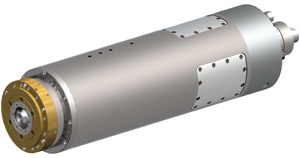
For a high efficiency of the machine in the user-specific appli­cation the spindle choice is essential. Therefore, Röders offers an excep­tio­nally wide range of main spindles.

For a high efficiency of the machine in the user-specific appli­cation the spindle choice is essential. Therefore, Röders offers an excep­tio­nally wide range of main spindles. By means of a standar­dized interface, which has been optimized over many years, especially thermally, the main spindles are mounted in the Z‑axis of the machines. This allows for a cost-effective change to another spindle type at a later time, in case the appli­cation for the machine changes. Options like vector control, axis cooling for high precision, lead throughs etc. are available as needed. Röders always has spare spindles in stock for all spindle types.

In case an appli­cation requires very high rpm and also a relatively powerful spindle, Röders offers the possi­bility to equip a machine with two main spindles. Further infor­mation can be found at: Double Spindle machine – Option Z2.
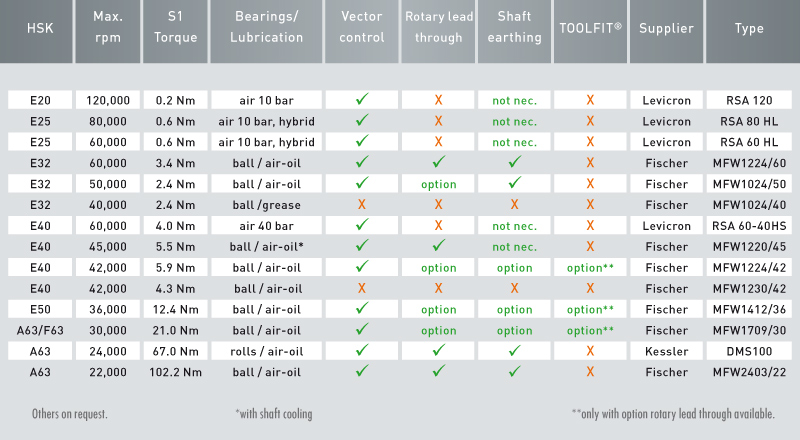
Table main spindles, © Röders GmbH

Drive Technology

The Röders Drive Technology

Röders Regelungstechnik, Drive Technology

Höchste Konturgenauigkeit

Highest precision of the machining path

  • Circular precision of < 1 μm possible

Exakte Temperierung

Exact temperature stabilisation

  • Hyste­resis of the cooling water for tempe­rature control of the machine < +/-0.1 Kelvin
  • Optio­nally for special requi­re­ments +/- 0.02 Kelvin

Smallest Increments

Smallest increments of movement

  • Internal resolution of the drives < 1 nanometre
  • Even smallest incre­ments possible

Energy-saving

With a sophisti­cated drive technology as well as lower friction in the axis, the linear motor technology reduces the power consumption compared to machines with ball screw drives:

  • by 12% for the same machining time
  • by 20% for the same workpiece quality

Control

The Röders Control RMS6

Röders GmbH Terminal RMS6
Icons Steuerung Control RMS6

PC-based control

  • Only a few operating elements for extremely simple operation of the PC-based control
  • USB interface, indus­trial mouse and 19” TFT screen standard
  • NC-programs in ISO-format or Heidenhain®#-format (with limited scope), mixed code also possible
  • Compa­tible with INDUSTRY 4.0
  • Quick familia­rization and operation using icons, text and hotkeys

Röders GmbH PRECITEMP Grafik Schwingungsüberwachung Spindel Graph vibration monitoring of the spindle

Vibration monitoring of the spindle

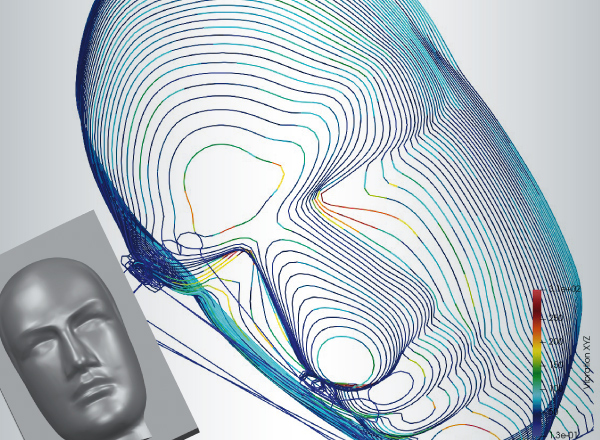
The use of high-speed spindles requires a limitation of the maximum spindle load in order to avoid bearing damage or a severe reduction in service life. Optio­nally, the spindles can be equipped with vibration sensors. A function in the control can be activated that automa­ti­cally reduces the feed and, if necessary, the RPM of the spindle in the event of high vibra­tions. In addition, a coloured graphic illus­tration of the vibra­tions along the milling path is possible. As a result, any areas in the milling path with high vibra­tions can easily be identified and can safely be avoided in recurring machining processes by adapting the CAM programming.


Spindle Compensation PLUS

Compensation of spindle elongation

Röders machines have been known for years for their external high-precision sensor for spindle elongation compen­sation. A holder fixed in the casting of the Z‑axis and kept geome­tri­cally stable with a tempering circuit carries a sensor at the end that contactless measures the displa­cement of the rotating spindle shaft in nano meter range. This is compen­sated for in the control system. Since the heat from the spindle shaft is trans­ferred into the tool holder and it also lengthens as a result, a short warm-up phase had to be programmed for high-precision machining appli­ca­tions before starting the machining operation.

Meanwhile, the Röders techni­cians have succeeded in modelling the dynamic heating process directly after the spindle has accele­rated to full RPM, so that with the new option Spindle Compen­sation PLUS a warm-up phase can be skipped completely in many applications.


Logo umati Partner

Röders is partner of the umati initiative of the German machine tool association VDW (umati = universal machine tool interface). The umati interface enables a standar­dized data transfer to the machines of numerous suppliers. umati is an essential step towards industry 4.0.


Control Characteristics

Control technology optimised for HSC

Outstanding charac­te­ristics of the Röders RMS6 control:

  • Block processing time < 0.1 ms
  • Look ahead > 10,000 blocks
  • Conti­nuously improved spline inter­po­lation and speed determination

Newest Control Versions

Performance increase through control updates

Newest control versions also for older machines(from year of manufacture 1995) available at low cost with the special Röders update service

Higher precision, better surface quality and signi­fi­cantly shorter machining times

Easier operation, as all Röders machines can have the same control version despite different years of production


Speed Optimisation

Automatic minimisation of vibrations

Automatic spindle speed optimi­sation by the machine within a user-selec­table range in order to minimise vibra­tions and achieve the highest possible surface quality; patented


Tangential Transitions

Tangential transitions

Patented function to avoid offsets in transi­tional areas if several different tools are used for machining
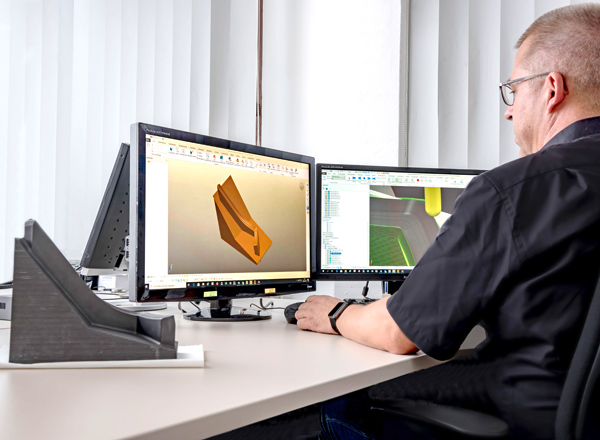
  • Automatic modifi­cation of the machining programs for tangential transitions

Postprozessoren

Postprocessors

  • Simple individual programing of postpro­cessors for all CAD/CAM-systems with the help of the Röders postpro­cessor handbook
  • Postpro­cessors for all common CAM systems available
  • Complete output of all NC-parameters by the CAM-system
    Programing at the machine control not necessary

Röders GmbH Steuerung Screen 1
Röders GmbH Steuerung Screen 2
Röders GmbH Steuerung Screen 3
  • Processing of ISO-NC-programs (G‑code) or Heidenhain®#-NC-programs (with limited scope) possible
  • very short familia­rization time
  • Basic-like programming for special appli­ca­tions possible
  • Changeover to Röders control very simple because no new programming language has to be learnt
  • Also a mixed use of ISO-NC-commands and Heidenhain®#-NC-commands is allowed

Screenshot optimaler Werkzeugeinsatz

Optimised use of tools

Numerous functions for optimised use of tools
  • Sister tools
  • Wear criteria
  • Maximum tool life travel
  • Measu­rement strategies
  • Geometry identi­fi­cation and test
  • Adminis­tration and import of tool types etc.

Röders GmbH Steuerung RACECUT

Further control functions

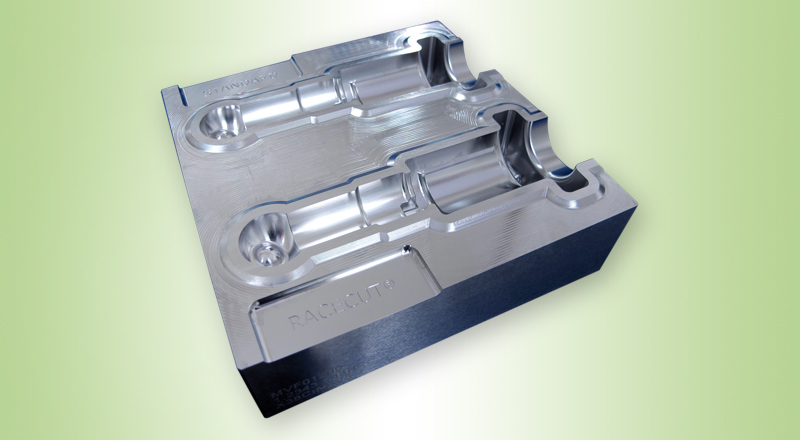
  • RACECUT® – Perfor­mance boost in machining 3D contours
  • 32 kHz drive control frequency and an optimized tool path planning in the control lead to signi­ficant reduc­tions of machining times, up to 20% while surface quality and precision remain equal
  • Since the energy (power) consumption of the machine is relatively constant regardless of the selected dynamics, the energy saving is of the same amount

#Heidenhain is the regis­tered trade mark of the Dr. Johannes Heidenhain GmbH.
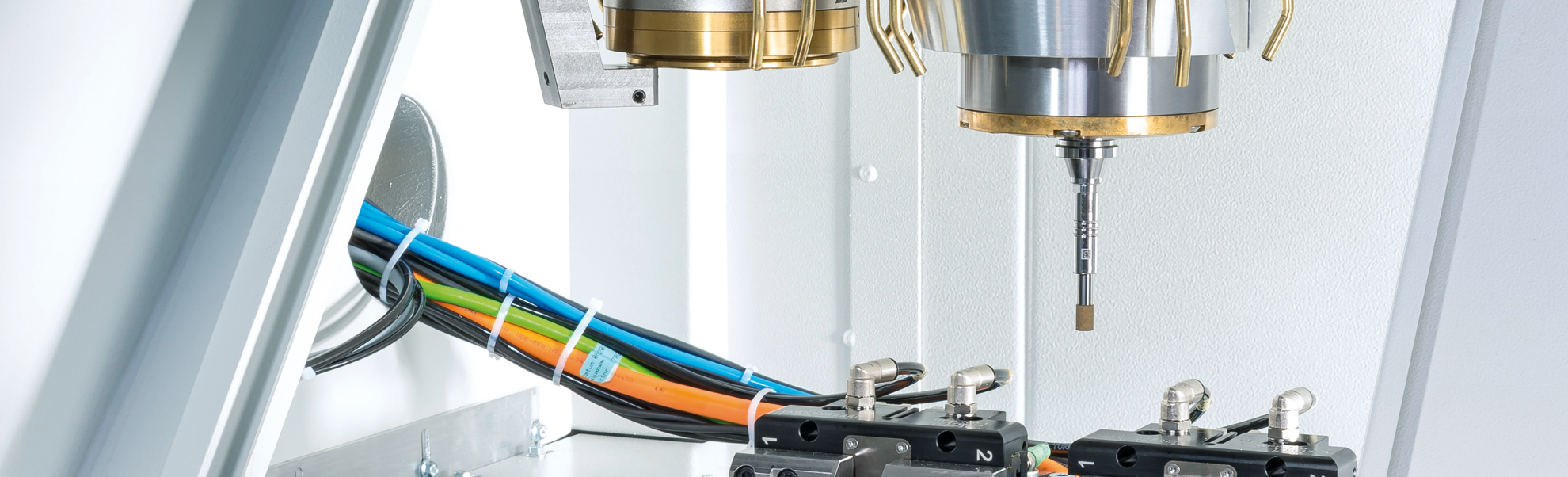
Double Spindle Machine

Detail Zweispindler

Double Spindle Machine – Option “Z2”

Innenraum Z1 Zweispindler

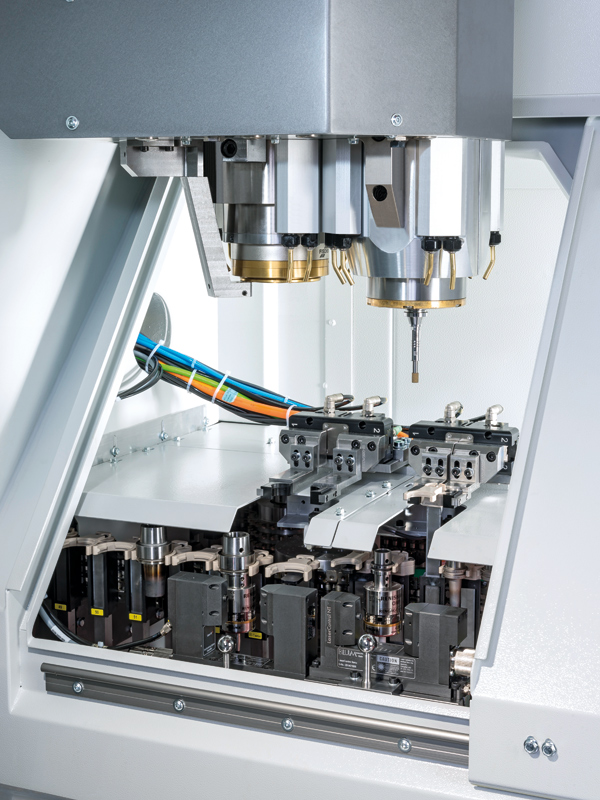
In some appli­ca­tions the choice of the main spindle is difficult, because either the maximum RPM of the main spindle is not suffi­cient or the maximum tool size allowed in the spindle is not large enough. This affects especially appli­ca­tions with optical surface quality or jig grinding, in case very small radii, for example in small holes, are to be machined with very high rpm, but also where larger tools are required for other operations.

In such cases, Röders offers the possi­bility to equip a machine with 2 main spindles, one more robust for larger tools and one with high rpm, for example:

  • Spindle 1: with ball bearings, HSK E50, 36,000 rpm max.
  • Spindle 2: with air bearings, HSK E25, 80,000 rpm max.

Both spindles are fully integrated in the machine so that the automatic tool changer, laser measu­rement, different coolants, 3D touch probe and in jig grinding machines all of the equipment for dressing, sound detection etc. are available for each spindle.

The axes of both spindles have a short distance to each other, but the spindles are highly precisely tempered with several cooling circuits. This ensures that the distance between the spindles and the positions of the spindles remain absolutely constant. As a result, in appli­ca­tions where both spindles are used a very high consis­tency of the work piece origin is achieved. Two spindles are utilized for one work piece set-up.

The option “Z2” currently is available for the machines RXP601DS, RXP601DSH, RXP801, RXP950, RXP950DSH and for all RPT and RXU machines. In the RPT and RXP machines the distance between the two spindle axes is 150 mm, in the RXU machines the distance is 225 mm.
Other machine models may be equipped with two spindles upon request.


Tool changer for two main spindles with different HSK holders
Werkzeugwechsler für zwei Hauptspindeln

Jig Grinding

Spindel - Schleiftechnologie

Technology for Grinding

Röders RPT Dynamik Schleifprozess, Dynamic Grinding Process
Optimised grinding process
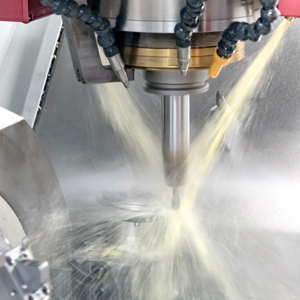
  • Precisely tempe­rature-controlled, flushing grinding oil
  • Chop grinding with slow contour feed rate
  • Contour grinding with slow Z‑motion and high feed rate
  • High surface qualities possible with Ra < 0.01 µm

Verlässliche Präzision
Reliable Precision
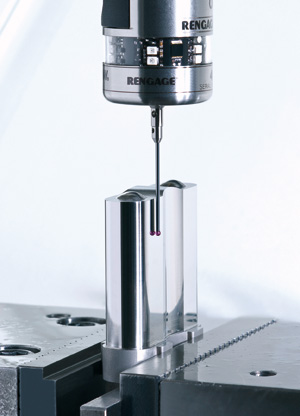
  • Check measu­re­ments with the automatic 3D touch probe of the machine
    permit the production of minimised tolerances for the workpiece, even in unattended operation

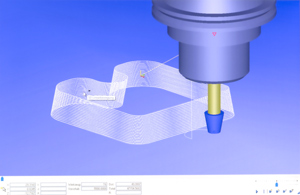
Röders GmbH Screen Simulation Grinding Cycle Programming
Röders GmbH Screen Simulation Conegrinding
CAM programming for jig grinding
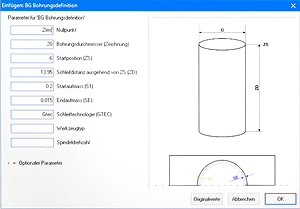
  • Very simple user interface for input of the grinding parameters at the control
  • Cycles for chop grinding and for contour grinding with slow Z‑motion available
  • Externally programmed or constructed contours may be imported
  • Also conical contours are easily programmed and machined, incl. dressing of the wheel

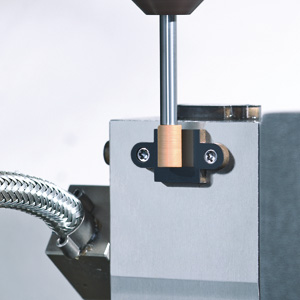
Röders GmbH Abrichten des Schleifstiftes - dressing up spindle
Dressing of the grinding wheel
at the rotating dressing spindle
  • Special cycles available for dressing
  • Preli­minary measu­rement of the grinding wheel in the measuring laser for a “rough measurement”

Körperschallvermessung des Schleifstiftes
Contact measu­rement
of the grinding wheel

The contact measu­rement is used for

  • precisely measuring the grinding wheel on diamond surfaces
  • measuring the workpiece
  • monitoring the grinding process

Schleiföl / Löschtechnik
Grinding oil / extin­gu­ishing equipment
  • Special precisely tempe­rature-controlled and fine-filtered grinding oil for optimal grinding results
  • Reliable two-channel extin­gu­ishing equipment for the entire machining area